Composition Seminar
2024 Semester 1
Fair Copy - Score -


Annotated - Score -


The Passover
The Passover is a programmatic piece for unaccompanied choir. It portrays "The Passover" - an event described in Exodus 12:
Exodus 12:21-23 & 29-32
21 Then Moses called for all the elders of Israel and said to them, “Go and take for yourselves lambs according to your families, and slay the Passover lamb. 22 You shall take a bunch of hyssop and dip it in the blood which is in the basin, and apply some of the blood that is in the basin to the lintel and the two doorposts; and none of you shall go outside the door of his house until morning. 23 For the Lord will pass through to smite the Egyptians; and when He sees the blood on the lintel and on the two doorposts, the Lord will pass over the door and will not allow the destroyer to come in to your houses to smite you.
29 Now it came about at midnight that the Lord struck all the firstborn in the land of Egypt, from the firstborn of Pharaoh who sat on his throne to the firstborn of the captive who was in the dungeon, and all the firstborn of cattle. 30 Pharaoh arose in the night, he and all his servants and all the Egyptians, and there was a great cry in Egypt, for there was no home where there was not someone dead. 31 Then he called for Moses and Aaron at night and said, “Rise up, get out from among my people, both you and the sons of Israel; and go, worship the Lord, as you have said. 32 Take both your flocks and your herds, as you have said, and go, and bless me also."
It's a beautiful story that me reminds of God's Justice and Mercy, of His faithfulness to those who put their trust in him, and of my own 'Passover lamb' - Jesus, who's blood saves me from destruction.
I tried to portray through the dark minor tonality of the piece, the anguish of the Egyptians who endured God's judgement, the suffering of the Israelites at the hand of the Egyptians, and the people of both nations crying out for God's mercy. At the same time, I wanted to portray the faith that the Israelites had in God and the deliverance that He ultimately did give to His people, by ending the piece in the hopeful parallel major key.
I'm very new to writing for unaccompanied choir, but after the success I found in writing a Hebrew choral section in my piece "In The Beginning", I decided to give it a try - especially after having become better acquainted with the classical singers in my year.
I've always loved the human voice as an instrument, especially in the context of a choir. This was heightened when I discovered the music of Pavel Chesnokov and other Russian choral composers of the 19th and 20th centuries. Their music is incredibly emotionally expressive and they have a distinct sound to them - not only because of the incredible low bass singers they write for. Western choral music (from every century) tends to sound very pure and light and 'proper', much like the instrumental music of Mozart's day. 19th and 20th century Russian choral music by contrast, is much more like the instrumental music of the Late Romantic era - emotional, full of lush harmony, heavy, and even gritty at times.
All this is to say that I was primarily inspired by the music of Pavel Chesnokov and, more generally, by various other sacred choral pieces from Russia in the 19th and 20th centuries. I did also find inspiration in the piece "Agnus Dei" by Samuel Barber, though.
After receiving feedback that I should also try and draw from Jewish folk music, I found a beautiful Jewish folk song called "Oyfn Pripetchik". My understanding is that the song expresses the suffering, tears, heroism, and tribulations of endless wandering in exile of the Jewish people, through a picture of children crowded around their rabbi in a heated room, learning the wonders of the alphabet. The lyrics in the fourth stanza hint at the traditional Yiddish saying "The history of the Jews is written in tears".
I thought this deeper meaning, as well as the folk song's beautiful melody and harmony, was perfect for my piece and I incorporated a reference to it in the sections that say "re'eh aneyi missn'ai".
The text is the original Hebrew text of Psalm 9:13. In English it says:
Be gracious to me, Lord;
See my oppression from those who hate me,
You who lift me up from the gates of death
I thought this Psalm was perfect for the piece. Reading it, I can't help but wonder if David also thought of God's deliverance of the Jews out of Egypt as he was writing it?
I had a lot of fun writing this piece. I think it turned out better than I could have hoped for and I can't wait to have it performed live!
- Audio -
- Oyfn Pripetshik -
Fair Copy - Score -


Annotated - Score -


Lazarus
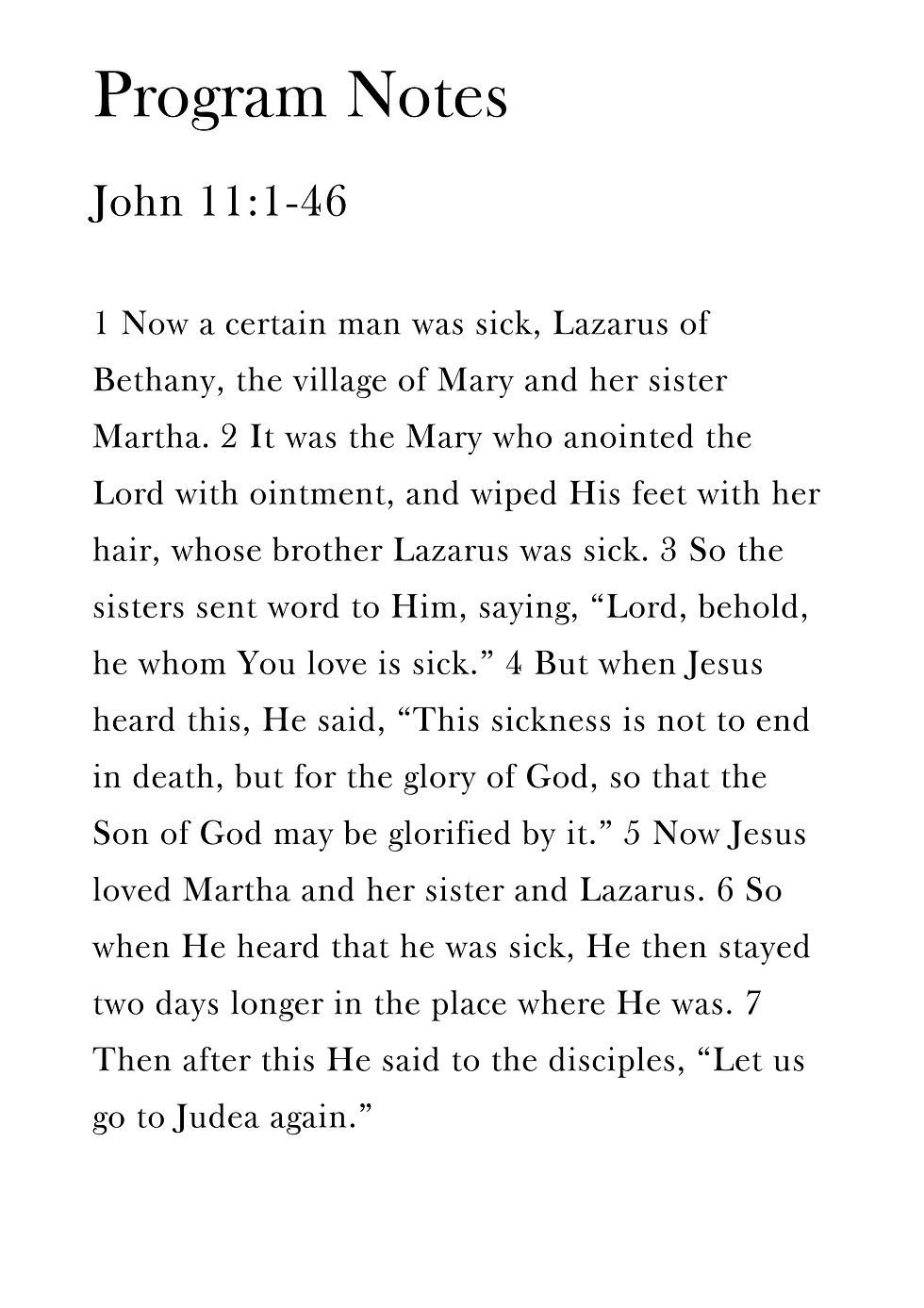
"Lazarus" is another programmatic piece that tells the story of the death and resurrection of Lazarus - which can be found in the book of John (the passage is long, so see the program notes for the account of the story.)
This story is important to me not only because it shows that Jesus has power and authority over death and points to His own death and resurrection, but also because it shows that death is sad - even when you know you'll see them again. It's a very freeing truth that's shown by the fact that Jesus himself wept even though he was about to raise his friend from the dead.
Unlike in the written story, my piece doesn't start with Jesus and his disciples. Rather, it begins with Mary and Martha mourning the death of their brother Lazarus and then moves into Jesus arriving, mourning with them, and finally performing the miracle of raising Lazarus back to life.
With this piece, I was inspired by Romantic era music including ballet music and other program music of that time. Specific pieces that influenced the creation of "Lazarus" include: "Miserere" from Il Trovatore and "The Death of Åse" by Edvard Grieg.
This piece also has some Hebrew lyrics when the choir comes in. This time, the lyrics are from Psalm 88:18 - the final verse in the chapter. This Psalm is notable for being one of the only Psalms that doesn't end on a positive note. In English, it says: "You have removed lover and friend far from me; My acquaintances are in darkness."
I thought this worked well for portraying the people mourning Lazarus' death.
The most challenging part of writing this piece was going from the dark sad first half and smoothly transitioning into the joyful celebration of Lazarus' resurrection.
I incorporated a lot of brass and organ to set the sombre tone of the story, with fragile melodies floating over the top, played by violin, flute, and piano among other things.
For the final section/s in particular, I drew inspiration from romantic ballet music to capture that joy in a very 'classical' and 'musical' way.
I like how this piece turned out. It will be interesting to see how it translates into a live performance context.
- Audio -
Fair Copy - Score -
The Lord is My Shepherd (WIP)
- Audio -
- Sketch 1 -


Annotated - Score -


The lord is My Shepherd isn't exactly a tone poem, but I did write it in response to the famous Psalm 23:
Psalm 23
1 The Lord is my shepherd,
I shall not want.
2 He makes me lie down in green pastures;
He leads me beside quiet waters.
3 He restores my soul;
He guides me in the paths of righteousness
For His name’s sake.
4 Even though I walk through the valley of the shadow of death,
I fear no evil, for You are with me;
Your rod and Your staff, they comfort me.
5 You prepare a table before me in the presence of my enemies;
You have anointed my head with oil;
My cup overflows.
6 Surely goodness and lovingkindness will follow me all the days of my life,
And I will dwell in the house of the Lord forever.
The piece is still a work in progress, but I want to capture the pastoral vibe of a shepherd tending to his sheep as well as the comfort and assurance that he gives to his sheep (in other words the comfort and assurance God gives to me.)
The imagery of green pastures and quiet waters is definitely something I also want to evoke in this piece.
The uncertainty of what instruments will be available to me for my recital makes it difficult to strike a balance between writing it how I envision it and just making do with the instruments that are more likely to be available to me.
- Sketch 2 -